Watch: why patients now ask AI which clinic to choose (90 seconds).
A patient with knee pain used to type “physical therapy near me” into Google and scroll. Today many of them simply ask an AI assistant: “Who is the best physical therapist in my town?” ChatGPT, Gemini, Perplexity and Google’s AI Overviews each answer with a short list of clinics. If your practice is not on that list, the patient may never see your name.
This guide explains where those answers come from, how to check what AI assistants say about your town in about ten minutes, and the practical steps that make your clinic easier for them to find and recommend.
Patients are already asking AI
In Rock Health’s 2025 survey of 8,000 US adults, 32% said they had used an AI chatbot for health information, double the 16% a year earlier. Among people who use AI, almost a third had used it for things like insurance questions and finding a provider.
Google is moving the same way. A 2025 study by Local Falcon of 60,000 local business searches found an AI Overview at the top of the results 40.2% of the time. So even patients who never open ChatGPT increasingly read an AI summary before they see the map or your website.
Where AI assistants get their answers
AI assistants do not have a secret list of clinics. They build each answer from information they can find and trust online. Each one leans on different sources:
| Assistant | What it mainly reads |
|---|---|
| Google AI Overviews and AI Mode | Google’s normal search results. Google says there are no special tricks: the usual SEO basics apply, and it specifically advises keeping your Business Profile information up to date. |
| Gemini | Google Maps. Since December 2025 the Gemini app shows local places as cards with photos, star ratings and summaries of Google Maps reviews. |
| ChatGPT | Web pages from Microsoft Bing’s index: clinic websites, local guides, directories and review sites. In BrightLocal’s study of local searches, business websites made up 58% of the sources ChatGPT cited. |
| Perplexity | A live web search, with links to the pages it used shown next to the answer. |
The common thread: your Google Business Profile, your reviews, your listings on other directories and the pages on your own website. That is what you can work on.
Check what AI says about your town in 10 minutes
You do not need any tools to see where you stand. Open ChatGPT, Gemini and Perplexity, and look at Google’s AI Overview, then ask each one the same questions a patient would:
- “What is the best physical therapy clinic in [your town]?”
- “Where can I get physical therapy for a knee injury near [your town]?”
- “Which physical therapist in [your town] takes [an insurance you accept]?”
- “Is [your clinic name] a good physical therapy clinic?”
For each answer, write down three things: whether your clinic is named, which competitors are named instead, and what reasons the assistant gives (for example “highly rated”, “specializes in sports injuries” or “offers same-week appointments”). Those reasons tell you what the assistant has learned about each clinic.
Here is what a typical result looks like. The names below are an example, not a real search:
Example question: “What is the best physical therapy clinic in [your town]?”
Example answer: “Clinic A is highly rated for sports and post-surgery rehab. Clinic B has many reviews mentioning friendly staff and short wait times. Clinic C offers balance and vestibular therapy.”
Your clinic is not mentioned, even though you have treated patients in the town for years.
If that sounds familiar, the cause is usually one of the gaps below.
Why a good clinic gets left out
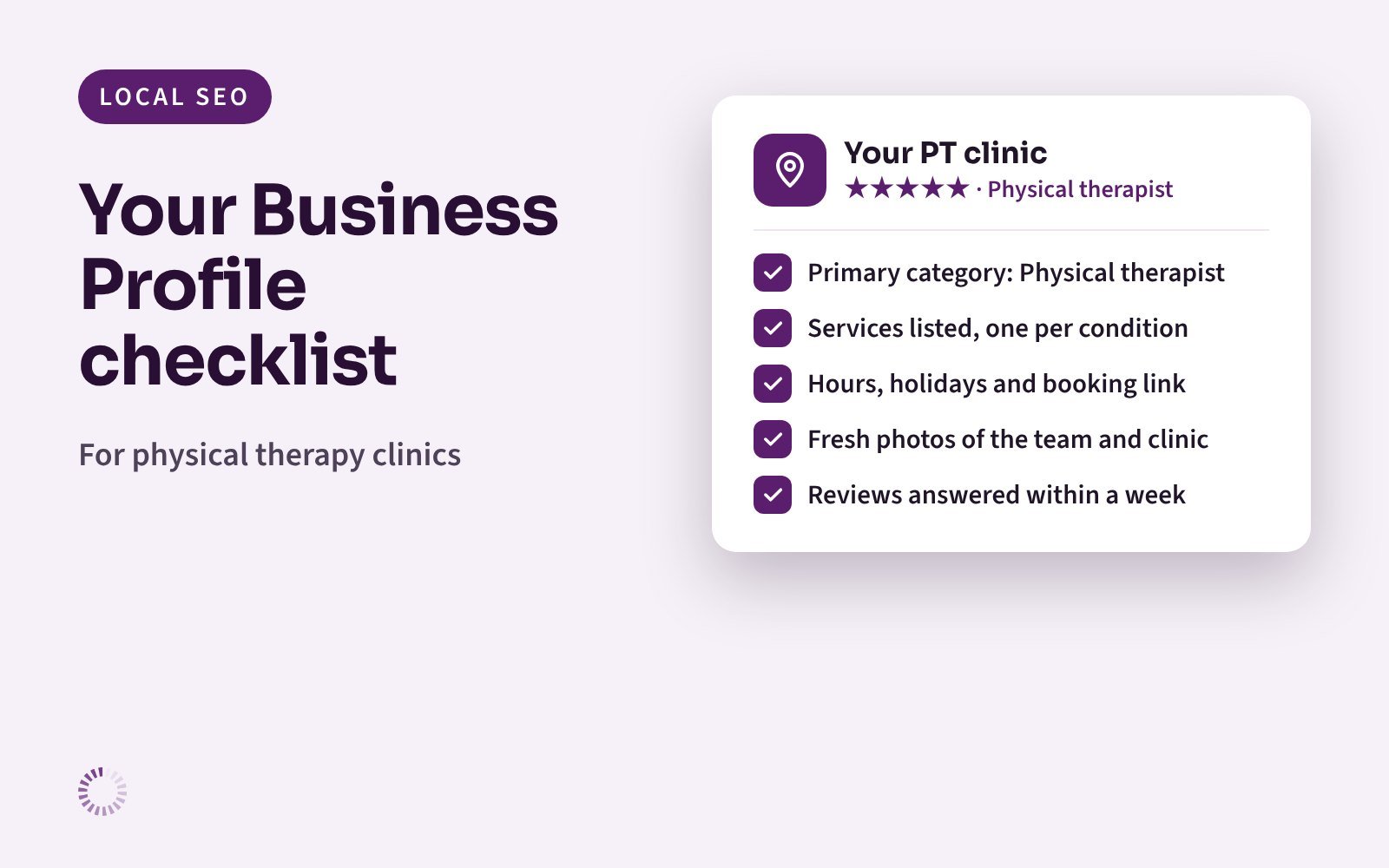
- An incomplete Google Business Profile. Missing categories, services, hours, photos or a thin description leave AI tools with little to say about you.
- Few or old reviews, with no replies. Assistants quote what reviewers talk about. If your latest reviews are two years old, competitors with fresh reviews are easier to recommend.
- Inconsistent listings. A different phone number or address on Bing, Apple Maps, Yelp or healthcare directories makes it harder for any system to be confident about your clinic.
- A website that does not answer patient questions. If your site has one “Services” page, there is nothing for an assistant to quote about knee pain, back pain or post-surgery rehab in your town.
- No mentions elsewhere. Local news, community sites, physician referral pages and “best of” lists are the kind of pages ChatGPT reads through Bing. Clinics that appear on them get named more often.
How to change what AI says about your clinic
None of this is a trick. It is the same work that helps you on Google Maps, done thoroughly and kept up every month.
- Complete your Google Business Profile. Choose the right primary category, add every service and condition you treat, keep hours current, and add real photos of your clinic and team. Post an update at least monthly.
- Ask every happy patient for a review, and reply to all of them. Make it easy with a link or a QR code at the front desk. Reply to every review, good and bad, without sharing any health details. Your replies show that you care, and they are part of what people and AI tools read.
- Claim your other listings. Make sure your name, address and phone number match exactly on Bing Places, Apple Business Connect, Yelp and the healthcare directories your patients use. Because ChatGPT relies on Bing’s index, Bing Places is worth the ten minutes it takes.
- Write one clear page for each main treatment. For example “Knee pain physical therapy in [your town]”. Answer the questions patients actually ask: what to expect at the first visit, how many sessions it usually takes, whether you take their insurance and whether they need a referral.
- Add a short FAQ. Simple question-and-answer sections are easy for AI tools to lift and quote. Keep each answer to two or three plain sentences.
- Earn local mentions. Sponsor a school team, give a talk at a senior center, or offer a free injury screening at a local race, and make sure the event pages link to your site. These mentions are exactly the kind of pages AI assistants find.
- Keep your website easy to read for search engines. Make sure pages load fast on phones and are not blocked from search engines, and that your clinic details on the site match your listings.
What results to expect
AI assistants change their answers often, and no one can guarantee that your clinic will be named. What you can do is give them more good, consistent information about you than your competitors give them. Most practices start to see the effects of this work, on Google Maps and in AI answers, about three months after they begin.
Check the same questions once a month and keep a simple note of who gets named. Over time you will see which changes move your clinic onto the list.
Want us to run the check for you?
Our free AI visibility report does this for your practice. Within two business days we send a short, plain-English report showing what ChatGPT, Gemini, Grok, Perplexity and Google AI Overviews say about your town, your Google Maps ranking for the searches patients use, and three fixes you can make yourself this week.
Get my free AI visibility report
Sources
- Rock Health: Health AI insights from the 2025 Consumer Adoption Survey (8,000 US adults, surveyed December 2025)
- Local Falcon: The impact of Google AI Overviews on local business search visibility (2025)
- Google Search Central: AI features and your website (updated 10 December 2025)
- 9to5Google: Gemini app shows Google Maps places with photos, ratings and review summaries (11 December 2025)
- Search Engine Land: How does ChatGPT conduct local searches? (Damian Rollison, 2025)
- BrightLocal: Uncovering ChatGPT Search sources (December 2024)
Written by the Outreach Digital team.
← All articles