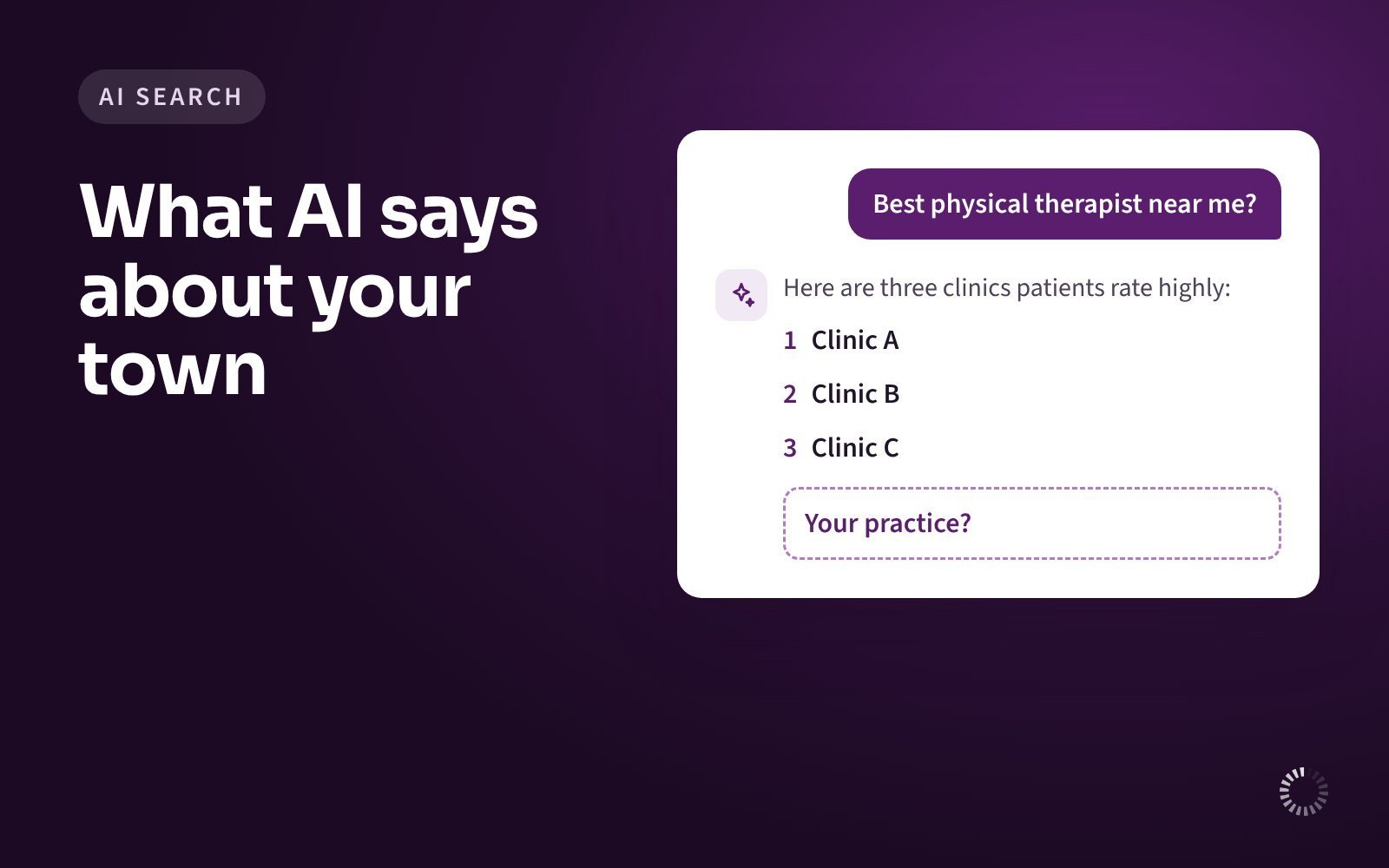
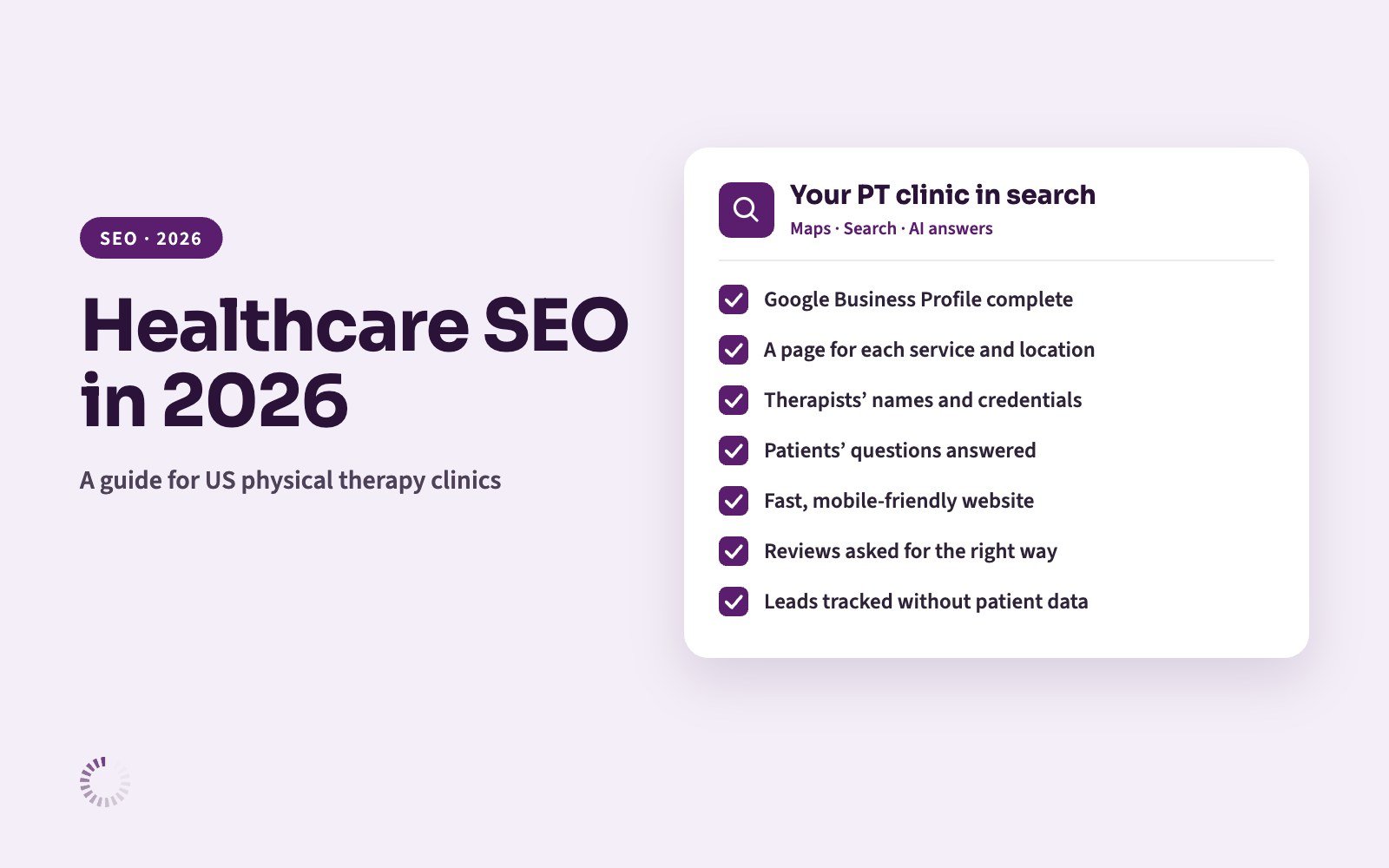
Patients looking for a physical therapist now find one in three places: the map at the top of Google, the regular search results, and AI answers such as Google’s AI Overviews and ChatGPT. Good healthcare SEO in 2026 means your clinic is easy to find, and easy to trust, in all three.
This guide covers the seven areas that matter most for a US physical therapy clinic, what Google’s own guidance says about each, and the mistakes we see most often. Where a topic needs more room, we link to a detailed guide.
Why search matters more for PT clinics now
According to the American Physical Therapy Association, patients in all 50 states and Washington, DC now have some form of direct access to physical therapy, meaning they can start treatment without a doctor’s referral. Some states still limit treatment without a referral, but more patients are choosing their own clinic, and many start that choice with a search.
How they search is changing too. In Rock Health’s 2025 survey of 8,000 US adults, 32% said they had used an AI chatbot for health information, double the figure a year earlier. A 2025 Local Falcon study of 60,000 local business searches found a Google AI Overview at the top of the results 40.2% of the time. So even patients who never open ChatGPT often read an AI summary before they see your website.
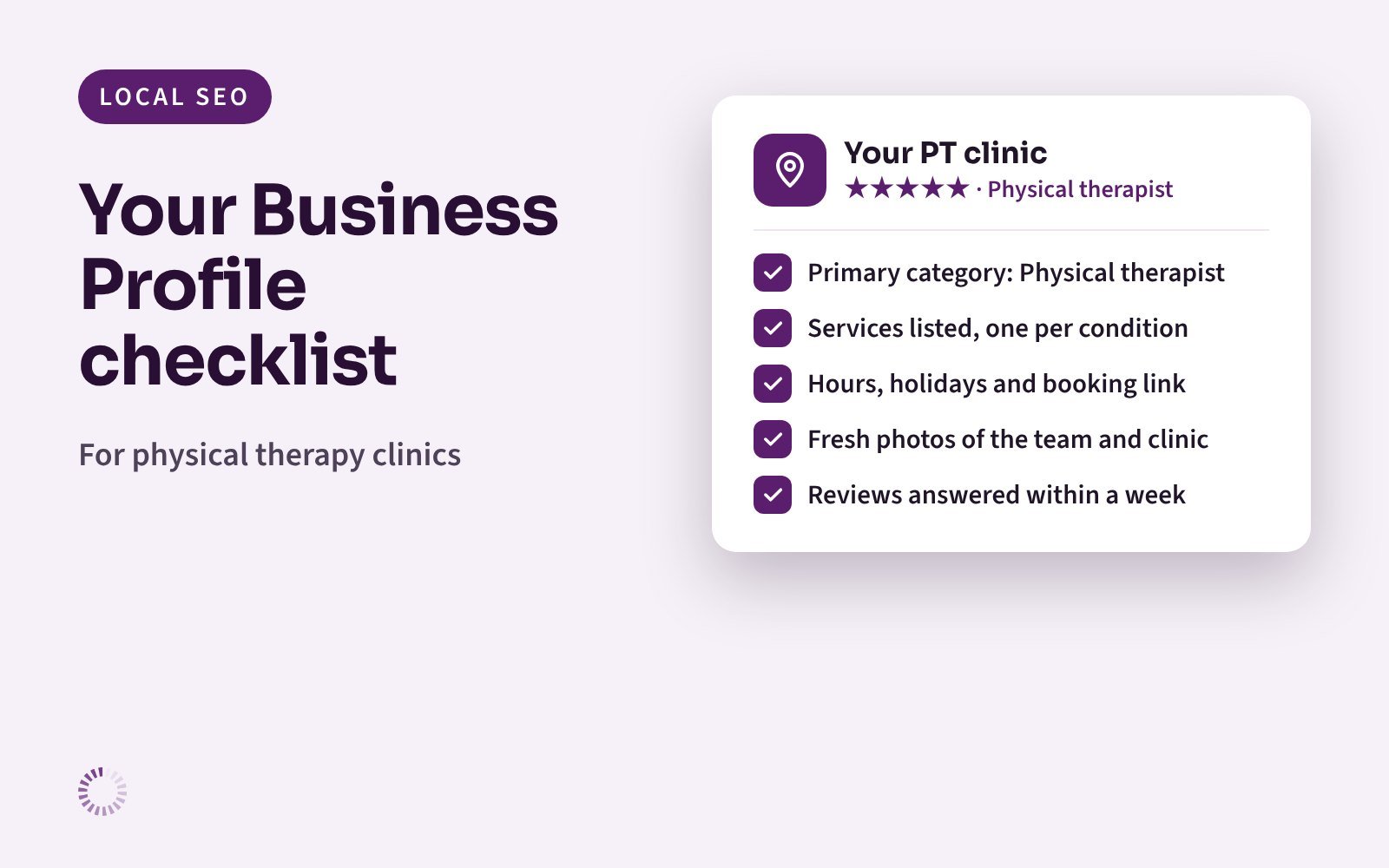
1. Your Google Business Profile comes first
For “physical therapy near me” and similar searches, Google shows a map with a short list of clinics above the regular results. Google says those clinics are chosen mainly by relevance, distance and prominence, and that there is no way to pay for a better local ranking. The basics:
- Use your real clinic name, with no services or towns added.
- Create one profile for each real, staffed location.
- Pick the most specific primary category, and as few extra categories as possible.
- Keep your hours accurate, including holiday hours.
- Add real photos of your clinic and team, and keep adding them.
Our Google Business Profile checklist for physical therapy clinics covers each item in detail.
2. One clear page for each service and each location
A patient with low back pain searches differently from one recovering from a knee replacement or one looking for pelvic health therapy. A single “Services” page with a list of bullet points rarely ranks well for any of them.
- Service pages: give each main service its own page, covering what it treats, who it is for, what happens at the first visit, and which insurance you accept.
- Location pages: if you have more than one clinic, give each its own page with the address, hours, therapists, parking and directions.
- Connect them: link each location page to its Google Business Profile, and each profile to its location page.
Avoid the shortcut of copying one page many times and changing only the town name. Google’s spam policy on scaled content abuse targets “large amounts of unoriginal content that provides little to no value to users, no matter how it’s created.” Each page should say something true and specific about that service or that clinic.
3. Show who is behind the care
Health is what Google calls a “Your Money or Your Life” (YMYL) topic, because it can affect people’s health and safety. Google says its systems give even more weight to content with strong experience, expertise, authoritativeness and trust (E-E-A-T) on these topics, and that of the four, trust matters most. For a PT clinic, that means:
- A team page with each therapist’s name, photo, credentials (for example DPT or OCS) and state license.
- A named author on every article, ideally a licensed therapist, or a note that a therapist reviewed it. Google “strongly encourages” accurate authorship information such as bylines.
- Real patient stories and reviews, shared with permission.
- Clear contact details, address, insurance information and clinic policies.
4. Answer the questions patients actually ask
The articles that work best answer the questions your front desk hears every day. Do I need a referral? Does my insurance cover physical therapy? How many visits will I need? Should I use heat or ice? A clear, direct answer helps the patient, and it is also the kind of passage an AI Overview or chatbot can quote.
Google says there are “no additional requirements to appear in AI Overviews or AI Mode, nor other special optimizations necessary.” The same SEO basics apply, and a page has to be indexed and eligible to show a snippet in Google Search. To see what AI assistants currently say about clinics near you, follow our guide to checking what AI assistants say about clinics in your town.
AI tools can help you draft articles, but a therapist should review every clinical statement before it goes live. Google suggests telling readers when AI played a substantial part in creating content, and mass-produced, unreviewed articles fall under the same scaled content policy described above.
5. Get the technical basics right
- Phones first. Many patients will search on a phone, often while in pain. Test every page on a phone, including forms and the call button.
- Speed. Google’s Core Web Vitals targets are: the main content loads within 2.5 seconds (Largest Contentful Paint), the page responds to taps in under 200 milliseconds (Interaction to Next Paint), and the layout stays steady while loading (Cumulative Layout Shift below 0.1). Google says good Core Web Vitals align with what its core ranking systems seek to reward. You can check any page for free with Google’s PageSpeed Insights.
- Structured data. This is code that tells search engines your clinic’s name, address, phone number, hours and services. Schema.org has a specific type for physical therapy clinics, called Physiotherapy.
- Indexing. Submit an XML sitemap in Google Search Console, and check its Pages report for pages that are not indexed.
- Forms. Use HTTPS on every page. Keep contact forms free of health details unless your form provider is HIPAA-compliant and will sign a business associate agreement with you.
6. Earn reviews the right way
- Ask every patient at a natural moment, such as their last visit, with a short link or QR code.
- Don’t reward or filter. Google’s review policy does not allow offering discounts, gifts or other incentives for reviews, or asking only happy patients. Since October 2024, the FTC’s rule also bans fake reviews and buying reviews.
- Reply without health details. As a HIPAA-covered provider, never confirm in a reply that the reviewer is a patient, or mention their condition or treatment. In 2022 a dental practice paid $23,000 to settle a HIPAA case that involved disclosing patient information in replies to online reviews.
7. Measure new patients without risking their privacy
SEO is only worth the effort if it brings in new patients, so measure calls, form enquiries and booking requests, not just website visits. A simple setup: send each form to a thank-you page, mark visits to those pages as key events in Google Analytics, and check the calls and direction requests shown in your Google Business Profile.
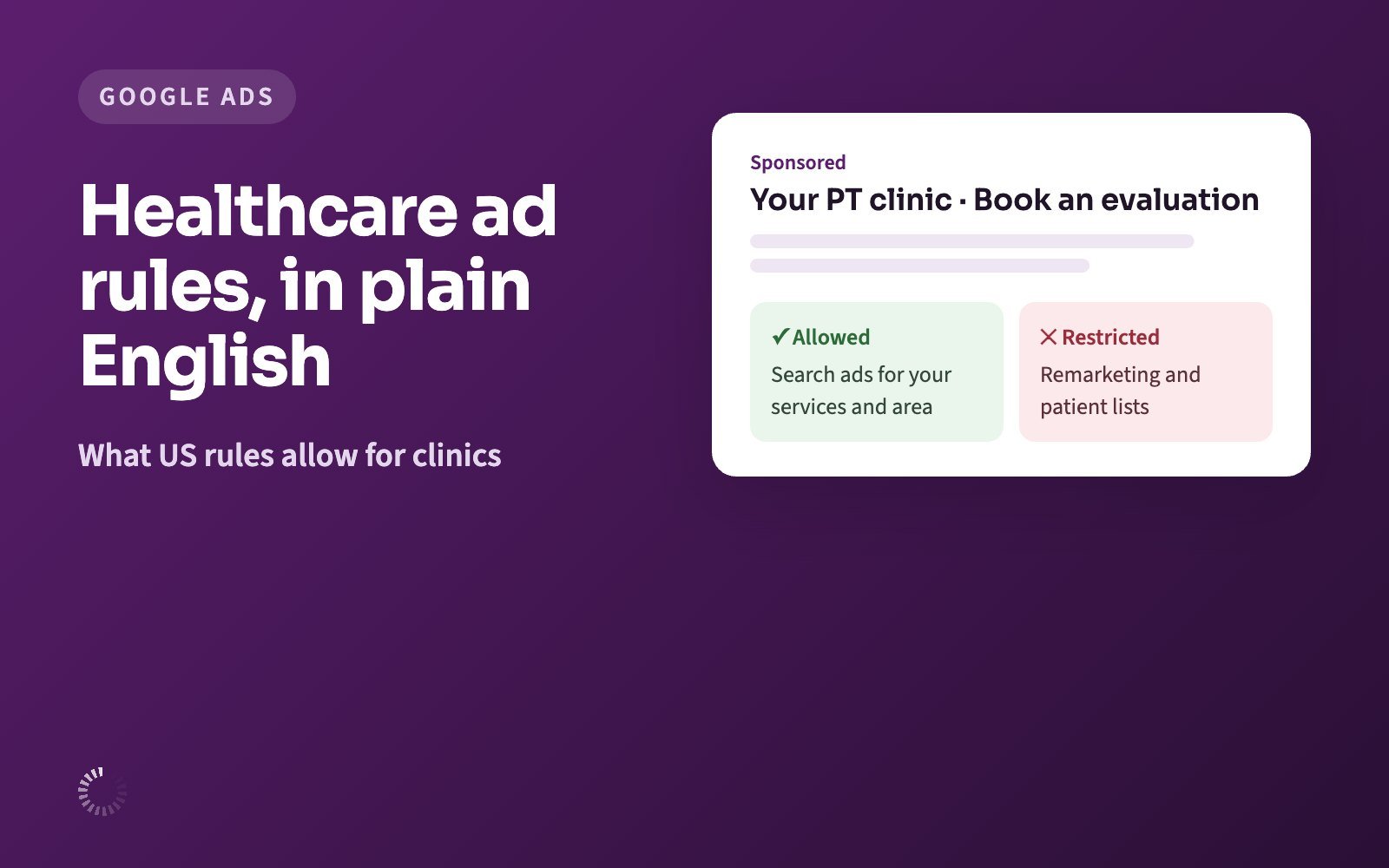
Be careful with tracking code on pages where patients log in, book or describe their symptoms. Guidance from the US Department of Health and Human Services (HHS) on online tracking technologies still applies to those pages, even though a federal court removed part of it in June 2024. Our article on Google Ads rules for healthcare explains a simple, compliant setup.
Mistakes we see most often
- Services or towns added to the Google Business Profile name.
- Dozens of copied location pages with only the town name changed.
- AI-written articles with no named author and no clinical review.
- Discounts or gifts offered in exchange for reviews.
- Tracking code on booking forms or patient portal pages.
- No way to tell which new patients came from search.
What results to expect
SEO builds over months, not weeks. In a video on hiring an SEO, Google said that it usually takes four months to a year to put improvements in place and start seeing their benefit. No one can promise a ranking. What you can do is give Google, and the AI tools that draw on it, the most complete, accurate and trustworthy picture of your clinic in your area. Check your Business Profile figures and Search Console each month, and judge the work by new patients, not rankings alone.
Want to know where your clinic stands?
Our free AI visibility report shows how your clinic appears on Google Maps, in search and in AI answers for the searches patients use, how you compare with nearby clinics, and three fixes you can make yourself this week. We send it within two business days.
Get my free AI visibility report
Sources
- American Physical Therapy Association: State of direct access to physical therapist services (25 June 2025)
- Rock Health: Health AI insights from the 2025 Consumer Adoption Survey
- Local Falcon: The impact of Google AI Overviews on local business search visibility (2025)
- Google Business Profile Help: Tips to improve your local ranking on Google
- Search Engine Journal: An in-depth look at Google’s spam policy updates (1 April 2024)
- Google Search Central: Creating helpful, reliable, people-first content (updated 5 October 2026)
- Google Search Central: AI features and your website (updated 10 December 2025)
- Google Search Central: Understanding Core Web Vitals and Google search results (updated 10 December 2025)
- Schema.org: Physiotherapy
- Search Engine Roundtable: Google updated the Business Profile review policies (20 February 2026)
- Davis Wright Tremaine: FTC finalizes rule banning fake consumer reviews (effective 13 October 2024)
- US Department of Health and Human Services: HIPAA settlement with New Vision Dental (14 December 2022)
- Morrison Foerster: Federal judge vacates portions of OCR guidance on online tracking technologies (June 2024)
- Search Engine Roundtable: Google says give SEOs 4 to 12 months (16 February 2017)
This article is general information, not legal advice. Google’s guidance changes, so check the pages above for the latest version.
First published on 6 June 2024. Rewritten for 2026 on 7 November 2026.
← All articles